


Research & Development Projects
We Understand Tomorrow’s Requirements
Since 2018, MTG has strategically prioritized post-quantum cryptography (PQC) and actively participates in research and development projects focused on analyzing, developing, and implementing quantum-resistant cryptographic methods. The goal is to develop reliable solutions early for use in security-critical infrastructures and to address future cryptographic requirements.
Insights gained through these activities are directly incorporated into the ongoing development of ERS® technology. MTG continuously works on integrating quantum-secure methods into core ERS® components such as PKI, Certificate Lifecycle Management (CLM), and Key Management Systems (KMS). New cryptographic approaches as well as current NIST-standardized PQC algorithms are evaluated and tested both in research projects and in product development.
At the same time, MTG closely follows international standardization processes and regulatory developments, including recommendations and guidelines from the Federal Office for Information Security (BSI). These developments are incorporated early into the technological evolution of ERS® technology to support organizations – especially those in security-critical industries – in preparing for the long-term impact of powerful quantum computers.
Bringing Post-Quantum Cryptography into Practice
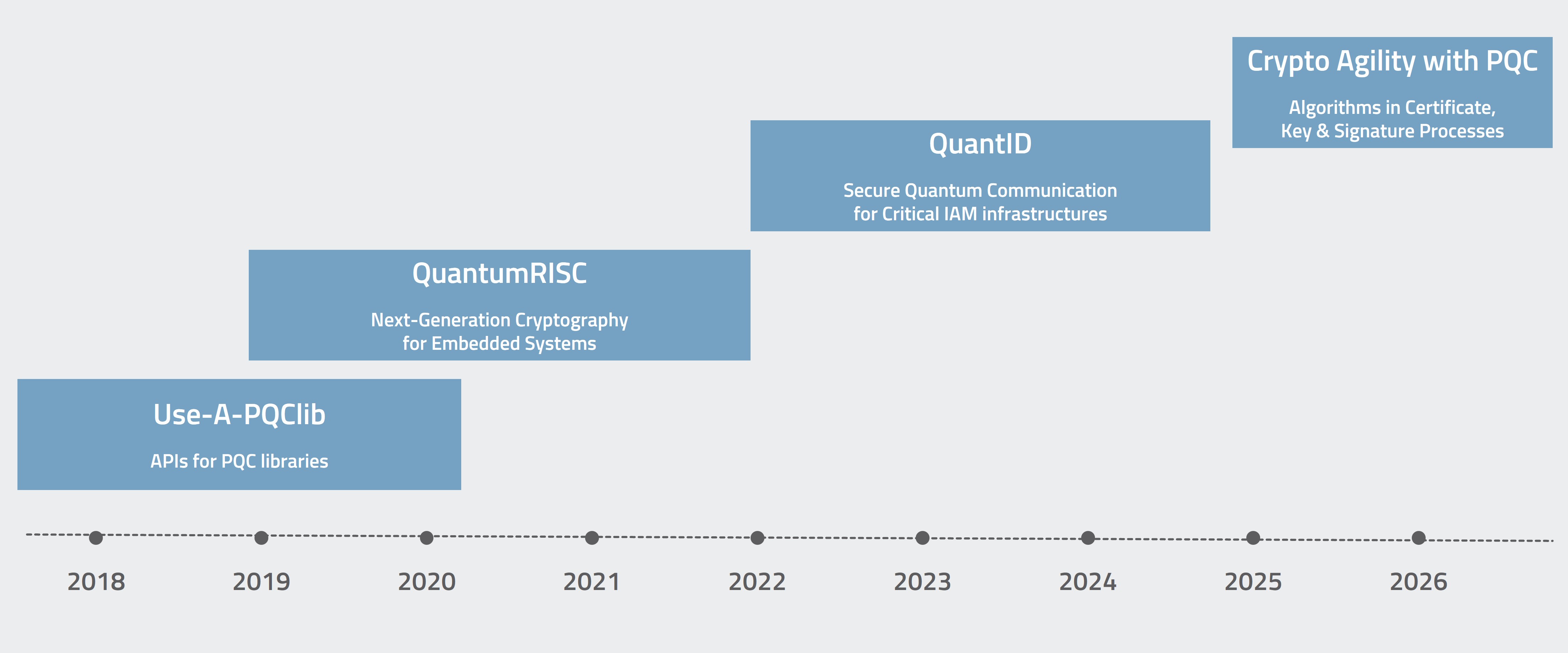
MTG PQC Funding Projects (© MTG AG)
Use-A-PQClib: Usable APIs for post-quantum cryptography libraries
Hessian Ministry of Science and the Arts (HMWK)
In collaboration with Darmstadt University of Applied Sciences, the PQC algorithms Classic McEliece and SPHINCS+ were implemented and integrated into the ERS products KMS and CARA. An online certificate authority issuing free PQC certificates was made publicly available. PQC extensions for an open-source browser and an email client were developed and released as downloads.The resulting software Sunray and Sunbeam were the world’s first publicly available PQC-enabled browser and email client.
QuantumRISC: Next-Generation Cryptography for Embedded Systems
BMBF – Research initiative in the field of “Post-Quantum Cryptography” within the framework of the German federal government’s IT security research program “Self-determined and secure in the digital world 2015 to 2020”.
In cooperation with the Fraunhofer Institute for IT Security, PQC algorithms were analyzed and improved. For example, the Classic McEliece algorithm was optimized with regard to memory usage and the results were published in a paper at the CARDIS 2020 conference.
Furthermore, an extension for the Utimaco HSM for the PQC algorithm XMSS was developed and implemented.
Learn more about Classic McEliece encryption for embedded devices here
QuantID: Secure Quantum Communication for Critical Identity Access Management Infrastructures
BMBF - Innovation Hub for Quantum Communication, in cooperation with Quant-X Security & Coding GmbH, the University of Regensburg and the Fraunhofer Institute for Photonic Microsystems (IPMS)
Within the project, the PQC algorithms ML-KEM, ML-DSA and SLH-DSA, standardized by NIST, were implemented and integrated into the ERS products CARA. In cooperation with the University of Regensburg and CryCryspen Sarlspen Sarl, a scientific paper on the topic of PQC linting was created and accepted at the International Conference on Applied Cryptography and Network Security (ACNS, 2025).
The paper focuses on validating X.509 certificates with PQC keys and defining meaningful linting rules for the new PQC algorithms ML-KEM and ML-DSA. Methods for linting PQC certificates were integrated into the open-source project jzlint.
Crypto Agility with PQC
Certification Body for Research Allowance (BSFZ)
Within the research project, MTG ERS® will be extended with Post-Quantum Cryptography (PQC) in order to prepare customers at an early stage for future security requirements.
New PQC algorithms will be integrated into certificate, key and signature processes. The new PQC algorithms support hybrid approaches, i.e., established classical methods (such as RSA or elliptic curves) are combined with new quantum-resistant algorithms (such as ML-KEM or ML-DSA). This makes it possible to protect data today against “store now, decrypt later” attacks while at the same time continuing to use the established security of classical cryptography. The Federal Office for Information Security recommends this combined use as a transitional solution.
In addition, adaptations will be made to the hardware security modules (HSM) for the new PQC algorithms. Since PQC methods require more memory and computing power and in some cases new key concepts, MTG is developing interoperable and secure implementations of the HSM abstraction for this purpose.